CORE Commercial Harbor Craft Funding Scheduled to Reopen December 1 2026
Charged Marine StaffCORE Commercial Harbor Craft Funding Scheduled to Reopen December 1 2026
Commercial harbor craft incentives offer California vessel operators a new opportunity to plan electric vessels, propulsion conversions and waterfront charging.
November 1, 2026
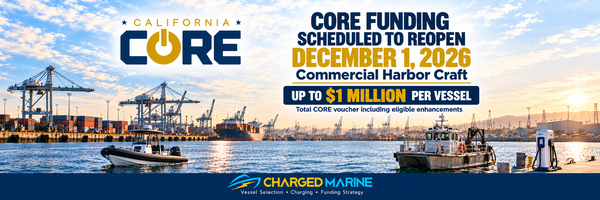
California’s Clean Off-Road Equipment Incentive Project, known as CORE, is scheduled to reopen its heavy-duty funding cycle on December 1, 2026, at 9:00 a.m. Pacific. For commercial marine operators, the opening provides an opportunity to pursue financial support for eligible zero-emission vessels and propulsion systems. [1]
Charged Marine helps vessel owners, fleet operators, marinas and manufacturers evaluate the equipment, infrastructure and funding needed to move a marine electrification project forward. With the opening approaching, now is the time to identify suitable vessels and begin coordinating with manufacturers and CORE-approved dealers.
Funding for the working waterfront
CORE has announced approximately $140 million across eligible off-road equipment categories for FY 2026–27, including an initial $3 million baseline allocation for commercial harbor craft. The broader funding pool combines a $68 million Air Quality Improvement Program allocation with rollover funding from previous cycles.
New voucher requests are scheduled to be accepted on a first-come, first-served basis through March 1, 2027. After the first 30 days, CARB plans to assess demand and adjust category allocations. Operators are encouraged to apply throughout the open window so demand can inform those decisions. The full $140 million is not dedicated to marine projects, and the initial harbor craft allocation is not a promise of an award to any applicant. [1]
How CORE works
CORE uses point-of-sale vouchers to help California purchasers and lessees offset the higher upfront cost of eligible zero-emission commercial equipment. The program also supports qualifying charging and fueling infrastructure associated with eligible equipment. CORE itself does not require scrapping an existing vessel or engine. [2]
For an operator, the funding can help bring an electric project closer to a workable budget. It should be evaluated alongside purchase price, vessel integration, infrastructure, operating costs and service support.
Which marine projects can qualify
The harbor craft guidance provides pathways for new vessels, new propulsion systems and conversion kits. Covered vessel types include ferries, excursion boats, tugboats, towboats, pilot boats, workboats, crew and supply vessels, fishing boats, research vessels and emergency-response craft. Recreational vessels are excluded from this harbor craft pathway. Purchasers must meet applicable regulatory and program requirements. [3]
The commercial use, exact equipment configuration and purchasing entity all matter. Operators should confirm eligibility with the appropriate approved dealer before making a purchase commitment.
Understanding the funding limits
CORE harbor craft vouchers are capped at $1 million per vessel, including small-business and shoreside infrastructure enhancements.
Qualifying small businesses can receive a 15% enhancement to the model-specific base voucher. Qualifying infrastructure support can reach $75,000 for shore power below 99 kW, or $100,000 for higher-power charging or zero-emission bunkering. These enhancements remain within the overall vessel cap.
Stacking CORE with other public incentives may be allowed, but every funding program’s rules must permit it. Combined public incentives cannot exceed the eligible vessel cost excluding taxes and fees. [3]
A catalog listing is therefore the beginning of a funding assessment. It does not establish the final award or the operator’s remaining project cost.
What vessels and systems are in the CORE catalog
CORE’s harbor craft catalog includes complete electric boats, propulsion packages for new construction and conversion systems for existing vessels. The following summary groups related models and configurations. Displayed amounts are base catalog incentives, not purchase prices or guaranteed awards. [4]
|
Manufacturer |
Listed families and applications |
Base catalog incentives |
|---|---|---|
|
Artemis Technologies |
EF-12 CTV, Escape, Pilot, Workboat and XL; EF-15 Escape and Pilot |
$695,000–$1 million |
|
Candela |
P-12 Business, Cargo, CTV, Shuttle and Voyager |
$1 million |
|
EV Maritime |
D600 and D1200 new-build electric driveline packages |
$750,000–$1 million |
|
Silverback Marine |
eAleutian Explorer, eApache, eGrizzly, eSherpa, eSuperCub and eVersaBarge |
$97,000–$240,000 |
|
Ghostworks Marine |
ECTO-10 ferry and M40 Minerva workboat |
$255,000–$420,000 |
|
Photon Marine |
FYG-28 and P300 conversion packages |
$93,000–$165,000 |
|
Flux Marine |
Hyfoil Dual Console package |
$150,000 |
|
Novelli Boat Builders |
Landing Craft 36-E, LTF 549-E and Veloche 349-E |
$520,000–$1 million |
|
Voltari Electric |
Patrol 26 CC and Patrol 26 Pilot |
$170,000–$250,000 |
|
VITA Power |
SeaDog 550, Seal 700 and conversion kits |
$140,000–$500,000 |
|
Vision Marine Technologies |
E-Motion 180E inboard, outboard and Outboard P Powerpack conversions |
$98,000–$170,000 |
|
Twin Disc |
CECK 5065H conversion kit |
$750,000 |
Complete electric vessels
Complete-vessel listings support a range of passenger and working-waterfront applications. Examples include Candela’s P-12 Shuttle, a 39-foot ferry listed with 336 kWh of batteries, and Artemis’s EF-15 Escape, listed with 540 kW of propulsion and battery options from 412 to 824 kWh. Both display $1 million base vouchers. [5, 6]
Smaller commercial platforms are also represented. Silverback’s dual-motor eGrizzly listing describes a 24-foot aluminum workboat with 126 kWh of batteries and a $240,000 base voucher. Novelli’s Landing Craft 36-E lists twin 149 kW outboards, 540 kWh of batteries and a $540,000 base voucher. [7, 8]
New vessel propulsion packages
Electric driveline packages provide an option for operators working with a designer or builder on new construction. EV Maritime’s D1200 listing includes a four-motor configuration with up to 1,240 kW of propulsion and 1,200 kWh of batteries, displaying a $1 million base voucher. [9]
The vessel design and propulsion package need to be evaluated together to establish the appropriate performance, capacity and charging requirements.
Conversion systems for existing boats
Conversion systems offer another route for operators with a suitable existing hull. Vision Marine, Photon Marine, VITA Power and Twin Disc have conversion listings in the catalog. Vision Marine’s E-Motion 180E outboard conversion with 129 kWh of batteries, for example, displays a $165,000 base voucher. [4, 10]
A repower assessment should examine hull condition, battery placement, weight distribution, propulsion requirements and the cost of integration. Keeping an existing hull can be attractive, but the complete conversion budget needs to be understood before proceeding.
Prepare the vessel and charging plan together
A credible project begins with the vessel’s daily work. Operators should document routes, speeds, passenger or cargo loads, hours underway, reserve requirements and time at the dock. Weather exposure and seasonal changes can also affect the appropriate equipment choice.
Charging needs the same early attention. Utility capacity, electrical upgrades, dock access, permitting and charger compatibility can affect both cost and delivery. Reviewing these factors alongside vessel selection helps avoid a situation where the boat is ready but the waterfront is not.
Maintenance support, crew training, warranty coverage and contingency plans should also be part of the initial evaluation. Incentive funding supports acquisition; a successful project must support reliable operations after delivery.
How Charged Marine can help
Charged Marine helps commercial vessel owners and waterfront businesses connect equipment selection with infrastructure planning and funding strategy. Services can include duty-cycle screening, manufacturer and dealer introductions, new-vessel-versus-repower analysis, utility coordination and project development support.
Before December 1, operators can define a candidate project, compare catalog options, assess charging requirements and coordinate application preparation with the appropriate approved dealer. That work makes the funding opportunity easier to evaluate and the project more concrete.
Planning an electric vessel purchase, commercial repower or waterfront charging project? Contact Charged Marine to explore CORE funding and develop a coordinated plan for your operation.
Information checked November 1, 2026. Final eligibility, voucher amounts, funding availability and application requirements are governed by current CORE program documents and approvals.
Sources
- CORE funding status and opening schedule: https://californiacore.org/ticker/
- CORE program overview: https://californiacore.org/
- CORE FY 2026–27 Implementation Manual Attachment E, July 15, 2026: https://californiacore.org/wp-content/uploads/2026/07/CORE-FY26-27-Implementation-Manual_Attachment-E.pdf
- CORE commercial harbor craft catalog and full category export: https://californiacore.org/equipment-category/harbor-craft/
- Candela P-12 Shuttle: https://californiacore.org/equipment/p-12-shuttle/
- Artemis EF-15 Escape: https://californiacore.org/equipment/ef-15-escape/
- Silverback eGrizzly: https://californiacore.org/equipment/egrizzly-10024qce-dual-motor-dual-battery/
- Novelli Landing Craft 36-E: https://californiacore.org/equipment/landing-craft-36-e/
- EV Maritime D1200: https://californiacore.org/equipment/d1200-1200-kwh-lithium-ion-nmc-batteries/
- Vision Marine E-Motion 180E: https://californiacore.org/equipment/e-motion-180e-outboard-129-kwh/
Contact: info@chargedmarine.com