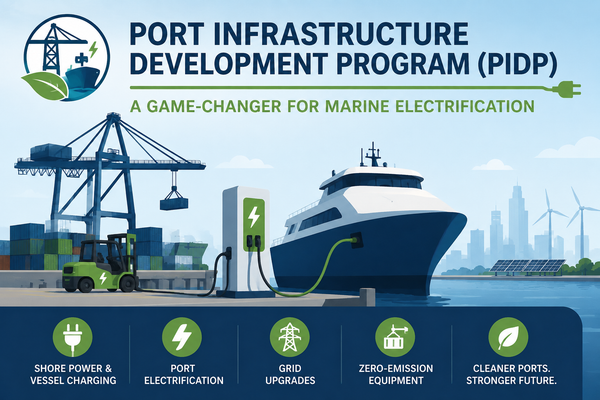
Port Infrastructure Development Program (PIDP): A Game-Changer for Marine Electrification
Charged Marine StaffHow America's Largest Port Infrastructure Grant Program Can Accelerate the Transition to Zero-Emission Ports and Waterfronts
As ports, marinas, and waterfront communities prepare for the future of maritime transportation, one federal funding program stands above the rest: the U.S. Maritime Administration's (MARAD) Port Infrastructure Development Program (PIDP).
With $488.6 million available in Fiscal Year 2026, PIDP represents one of the largest federal investments supporting the modernization of America's maritime infrastructure. While the program has traditionally focused on improving freight movement and supply chain efficiency, it also presents a significant opportunity to advance marine electrification through investments in charging infrastructure, electrical upgrades, shore power, and other zero-emission technologies.
For ports looking to reduce emissions, improve operational efficiency, and prepare for the next generation of electric vessels, PIDP can be a critical funding source.
What Is the Port Infrastructure Development Program?
The Port Infrastructure Development Program is a competitive grant program administered by the U.S. Department of Transportation's Maritime Administration (MARAD). Its primary purpose is to improve the safety, efficiency, and reliability of freight movement through America's coastal, inland, and Great Lakes ports. Projects are evaluated based on their ability to strengthen the nation's freight network, improve port operations, and generate long-term economic benefits.
Although the program is not exclusively focused on clean energy, many electrification projects naturally align with PIDP's objectives because they modernize port infrastructure while improving operational performance.
Why PIDP Matters for Marine Electrification
The maritime industry is entering a period of rapid technological change. Electric ferries, workboats, cargo handling equipment, and support vessels are becoming commercially available, while ports are under increasing pressure to reduce emissions and modernize aging electrical infrastructure.
Electrification cannot occur without infrastructure.
Ports need stronger electrical service, upgraded substations, charging systems, intelligent energy management, and resilient power distribution networks before electric vessels can operate at scale.
These infrastructure improvements are exactly the types of long-term capital investments that PIDP was designed to support.
Eligible Electrification Projects
Marine electrification projects that may align well with PIDP objectives include:
-
Shore power systems for commercial vessels
-
Electric vessel charging infrastructure
-
Medium- and high-voltage electrical distribution upgrades
-
Utility interconnections
-
Battery energy storage systems supporting port operations
-
Electrification of cargo handling equipment
-
Zero-emission cranes and terminal equipment
-
Port microgrids
-
Waterfront infrastructure improvements supporting electric vessel operations
-
Intermodal improvements connecting ports to rail and truck networks
Many of these investments improve both environmental performance and freight efficiency, making them highly competitive when incorporated into broader port modernization projects.
Who Can Apply?
PIDP is intended for public entities responsible for port infrastructure. Eligible applicants include:
-
State governments
-
Local governments
-
Port authorities
-
Public port districts
-
Tribal governments
-
Public agencies
-
Special purpose transportation districts
-
Multi-jurisdictional authorities
-
Public entities partnering with private companies through public-private partnerships (P3s)
Private companies typically participate by partnering with an eligible public sponsor.
Why Public-Private Partnerships Are Growing
Many of today's marine electrification projects involve multiple stakeholders.
A single project may include:
-
Port authority
-
Utility company
-
Electric boat manufacturer
-
Charging provider
-
Engineering firm
-
Local government
-
Terminal operator
PIDP specifically allows joint applications between eligible public entities and private partners, making it an excellent funding source for collaborative infrastructure projects.
Beyond Cargo Ports
Although PIDP is commonly associated with container terminals, the program can also benefit:
-
Great Lakes ports
-
Inland river ports
-
Ferry terminals
-
Working waterfronts
-
Fishing ports
-
Industrial marine facilities
-
Intermodal freight terminals
As electric commercial vessels expand into these markets, demand for charging and upgraded electrical infrastructure will continue to grow.
Building a Competitive Application
Successful PIDP proposals typically demonstrate benefits in several key areas:
Economic Impact
-
Job creation
-
Increased freight capacity
-
Reduced transportation costs
-
Regional economic development
Operational Improvements
-
Faster cargo movement
-
Reduced congestion
-
Improved reliability
-
Greater system resilience
Environmental Benefits
-
Reduced emissions
-
Improved air quality
-
Lower fuel consumption
-
Support for zero-emission transportation
Partnerships
-
Utility collaboration
-
Private investment
-
Regional coordination
-
Stakeholder support
Projects that deliver multiple public benefits tend to be more competitive.
The Future of Electrified Ports
Marine electrification is about much more than replacing diesel engines.
Future ports will increasingly integrate:
-
High-capacity vessel charging
-
Battery storage
-
Renewable energy
-
Smart energy management
-
Shore power
-
Electric cargo equipment
-
Digital infrastructure
-
Grid resilience
Ports investing in these technologies today will be better positioned to serve the next generation of commercial vessels while strengthening regional economies.
How Charged Marine Can Help
Developing a successful PIDP application requires more than identifying a project. Applicants need a compelling strategy, strong partnerships, technical planning, and a clear understanding of how the project advances freight mobility, economic development, and environmental performance.
Charged Marine works with ports, marinas, utilities, vessel manufacturers, and public agencies to develop marine electrification strategies, identify funding opportunities, build partnerships, and prepare competitive grant applications. Whether you're planning vessel charging infrastructure, waterfront electrical upgrades, or a comprehensive port electrification initiative, our team can help move your project from concept to funding.
Ready to Modernize Your Port?
The transition to zero-emission maritime transportation is accelerating, and federal funding is helping make it possible.
If your organization is exploring port electrification, charging infrastructure, or waterfront modernization, now is the time to begin planning. The right project—supported by the right partners and funding strategy—can position your port for decades of economic growth, operational efficiency, and environmental leadership.