Gilligan’s Island Reimagined: The S.S. Electric Minnow
Charged Marine StaffHow Electric Propulsion, Automation and Smart Navigation Would Have Changed a Three-Hour Tour

The original Gilligan’s Island followed seven people stranded on an uncharted Pacific island after the S.S. Minnow encountered a powerful storm during what was supposed to be a three-hour sightseeing tour. The classic cast included Gilligan, the Skipper, the Howells, Ginger, the Professor and Mary Ann.
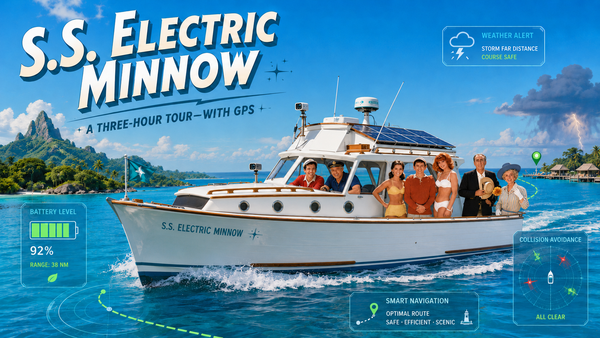
But what if the Minnow had been replaced by the S.S. Electric Minnow—a modern electric excursion boat equipped with advanced navigation, automation, satellite communications and intelligent safety systems?
The answer is simple: Gilligan’s Island might have lasted about 20 minutes.
Meet the Passengers and Crew
- Gilligan: The well-meaning but accident-prone first mate
- Captain Jonas “The Skipper” Grumpy: The experienced captain trying to keep Gilligan out of trouble
- Thurston Howell III: The millionaire who expects first-class service everywhere
- Eunice “Lovey” Howell: Thurston’s elegant and endlessly patient wife
- Ginger Grant: The glamorous Hollywood movie star
- Professor Roy Hinkley: The brilliant scientist capable of building almost anything
- Mary Ann Summers: The practical, resourceful farm girl from Kansas
A New Kind of Three-Hour Tour
It was a beautiful morning in Honolulu as the passengers boarded the gleaming S.S. Electric Minnow.
Instead of a smoky diesel engine, the vessel featured quiet electric propulsion, smart battery management, solar-assisted charging and a digital helm filled with modern navigation technology.
“Welcome aboard!” announced the Skipper. “We’re scheduled for a relaxing three-hour tour.”
Gilligan stood beside him wearing a new captain’s hat and holding a tablet.
“I’ve already entered our destination into the navigation system, Skipper!”
The Skipper looked suspiciously at the screen.
“Gilligan, you entered Kansas.”
Mary Ann smiled. “Well, I could use a trip home.”
The navigation system immediately responded:
“Destination exceeds available battery range. Please select a location within the Hawaiian Islands.”
The Professor nodded approvingly. “An excellent example of automated route validation.”
Mr. Howell looked concerned. “Does this boat at least have a first-class charging lounge?”
The Storm That Never Became a Disaster
Several miles offshore, the S.S. Electric Minnow’s weather-routing system detected a fast-moving tropical storm.
Before anyone aboard saw a dark cloud, the helm issued an alert:
“Severe weather approaching. Recommending immediate return to harbor.”
The software calculated a new course based on the storm’s movement, the vessel’s battery level, wave conditions and the locations of nearby safe harbors.
The Skipper studied the recommendation.
“In my day, we watched the clouds and trusted our instincts.”
The Professor leaned over his shoulder. “This system is analyzing satellite weather, wind speed, wave height and barometric pressure in real time.”
Gilligan looked toward the horizon.
“I’m analyzing the clouds, Skipper. They look angry.”
The Skipper pressed ACCEPT ROUTE.
The electric boat quietly turned toward Honolulu.
Automation Takes the Helm
As the weather worsened, the vessel’s autopilot maintained the safest course while its collision-avoidance system tracked other boats in the area.
When a large commercial vessel crossed several miles ahead, the navigation display identified it, calculated its direction and adjusted the Electric Minnow’s route.
Ginger looked at the screen. “How does the boat know where everyone is?”
“It uses digital vessel identification, radar and intelligent navigation,” explained the Professor.
Thurston Howell III pulled out his wallet.
“Can it identify which boats are owned by millionaires?”
“No,” said the Professor.
“Primitive technology,” Howell replied.
Gilligan Pushes the Wrong Button
Everything was going perfectly—until Gilligan noticed a flashing control.
“What does this button do?”
“Don’t touch that, little buddy!” shouted the Skipper.
Gilligan touched it.
The vessel immediately transmitted a digital distress alert containing its identity and precise GPS coordinates.
Within seconds, the Coast Guard contacted the boat through its satellite communications system.
“S.S. Electric Minnow, we have received your distress signal. Do you require assistance?”
The Skipper slowly turned toward Gilligan.
Gilligan smiled. “Good news, Skipper. If we ever get lost, they know exactly where we are.”
The Skipper took a deep breath.
“Cancel the distress call, Gilligan.”
The system confirmed that the boat was operating normally and automatically shared its updated position with the harbor.
The Battery Gets Everyone Home
The worsening waves increased the energy needed to return, but the vessel’s intelligent energy-management system continuously recalculated its available range.
Nonessential equipment was temporarily reduced, cruising speed was optimized and the system reserved enough battery capacity for docking.
Mrs. Howell watched the lights dim slightly.
“Thurston, I believe the yacht is conserving energy.”
“Nonsense, Lovey. I’ve never conserved anything in my life.”
The S.S. Electric Minnow arrived safely at the harbor with 27% battery remaining.
Automated docking assistance guided the boat toward its slip while cameras, sensors and electric thrusters helped the Skipper maneuver into position.
Gilligan picked up a dock line, tripped over a charging cable and accidentally connected the boat to the charger.
“Charging initiated,” announced the vessel.
The Skipper stared at him.
“Well done, Gilligan.”
Gilligan looked surprised. “What did I do?”
What Modern Technology Would Have Changed
If the S.S. Minnow had today’s marine technology, the passengers would have benefited from:
- Real-time storm detection and weather routing
- GPS navigation and automatic route planning
- Radar and collision-avoidance technology
- Automatic Identification System vessel tracking
- Autopilot and assisted docking
- Satellite communications
- Digital distress signaling and location sharing
- Emergency beacons transmitting the vessel’s position
- Remote vessel monitoring and diagnostics
- Intelligent battery and energy management
- Automated range calculations
- Quiet, emission-free electric propulsion
Instead of disappearing somewhere in the Pacific, the S.S. Electric Minnow would have been located, contacted and guided safely back to port.
The Shortest Television Series in History
The passengers stepped onto the dock three hours and four minutes after leaving.
Mary Ann headed for the farmers market. Ginger posted a video of the voyage. The Professor downloaded the boat’s operating data. Mr. Howell attempted to purchase the marina. Mrs. Howell booked another tour.
The Skipper reviewed the automated trip report.
Gilligan unplugged the charging cable before charging was complete.
And the S.S. Electric Minnow announced:
“Warning: Charging interrupted.”
“Gilligan!”
The modern version of Gilligan’s Island would not have been a story about seven people stranded for years on a deserted island. It would have been a story about seven passengers returning safely from a slightly rainy boat ride.
That might not have produced three seasons of television—but it would have demonstrated the enormous potential of electric propulsion, connected vessels, intelligent navigation and marine automation.
Sometimes the best adventure is the one that gets everyone safely back to the dock.